

Quick question: when’s the last time you thought about potassium?
If you’re like most people, the answer is “never, until my doctor mentioned it at my last checkup.” Potassium doesn’t get the spotlight that protein or fiber gets. There’s no potassium-shake aisle at the gym, no influencer doing a “30 days of potassium” challenge. And yet, this quiet mineral is doing more heavy lifting in your body than almost anything else you eat.
I want to walk you through what potassium actually does, how much you need, which foods deliver it best (with real calorie numbers, not vague “eat more veggies” advice), and a few things I’ve learned some the hard way about actually hitting your potassium target without obsessing over it.
Why Potassium Actually Matters
Potassium is an electrolyte, which is a fancy way of saying it carries an electrical charge that your cells use to function. Every heartbeat, every muscle contraction, every nerve signal in your body depends on the balance between potassium (inside your cells) and sodium (outside your cells). When that balance is off, you feel it: fatigue, muscle cramps, irregular heartbeat, or in more serious cases, dangerous spikes in blood pressure.
Here’s the part that surprises people: potassium’s biggest public health role isn’t about avoiding a deficiency disease. It’s about counterbalancing sodium. The average diet is loaded with sodium from processed food, and potassium is the mineral that helps flush it out and relax blood vessel walls. Research summarized by Harvard’s Nutrition Source consistently links adequate potassium intake with lower blood pressure and reduced cardiovascular risk, particularly when sodium intake is high.
I think of it less as “a nutrient I need” and more as “damage control for a diet that’s already working against me.” That reframe changed how I approached my own meals I stopped thinking about potassium in isolation and started thinking about the sodium-potassium ratio on my plate.
How Much Potassium Do You Actually Need?
This is where a lot of blog posts get sloppy, so let’s be precise.
For years, the U.S. recommendation sat at a flat 4,700 mg per day for adults. In 2019, the National Academies of Sciences, Engineering, and Medicine updated the Adequate Intake (AI) based on newer data:
- Adult men (19+): 3,400 mg/day
- Adult women (19+): 2,600 mg/day
- Pregnant women: ~2,900 mg/day
- Breastfeeding women: ~2,800–2,900 mg/day
You’ll still see 4,700 mg referenced on Nutrition Facts labels that’s the older Daily Value (%DV) figure the FDA hasn’t fully updated, so don’t let the math confuse you. The World Health Organization independently recommends at least 3,510 mg/day for adults, mainly for blood pressure and stroke prevention.
The uncomfortable truth: most adults in the U.S. get nowhere near either target. Average intake sits around 3,000 mg for men and 2,300 mg for women meaning a huge portion of the population is walking around in a mild, chronic shortfall without any obvious symptoms.
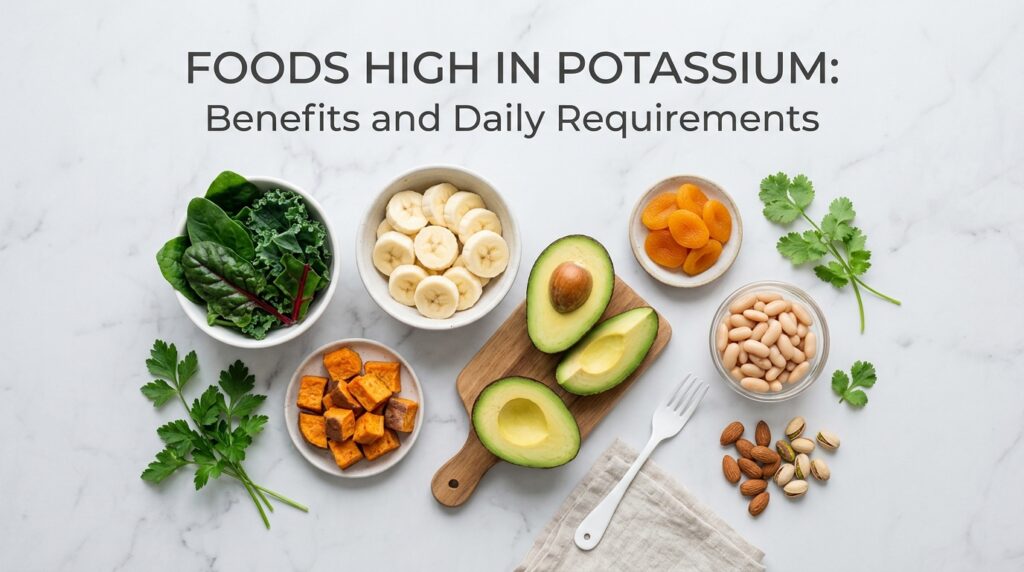
The Best Foods High in Potassium (With Calories, So You Can Actually Plan)
I’m listing these with calorie counts because “eat potassium-rich foods” is useless advice if you don’t know what it costs you calorically. A dietitian I spoke with while researching this piece put it well: “Potassium sources aren’t interchangeable in a calorie budget bananas and avocados both help your electrolytes, but they land very differently on your daily totals.”
| Food (typical serving) | Potassium | Calories |
|---|---|---|
| Sweet potato, baked, with skin (1 medium) | ~540 mg | ~112 |
| White beans, cooked (1 cup) | ~1,000 mg | ~250 |
| Spinach, cooked (1 cup) | ~840 mg | ~40 |
| Avocado (1 whole) | ~975 mg | ~320 |
| Banana (1 medium) | ~420 mg | ~105 |
| Salmon, cooked (3.5 oz) | ~490 mg | ~200 |
| Potato, baked with skin (1 medium) | ~940 mg | ~160 |
| Yogurt, plain (1 cup) | ~570 mg | ~150 |
| Orange juice (1 cup) | ~470 mg | ~110 |
| Coconut water (1 cup) | ~600 mg | ~45 |
| Lentils, cooked (1 cup) | ~730 mg | ~230 |
| Swiss chard, cooked (1 cup) | ~960 mg | ~35 |
A few things jump out once you line these up side by side. Leafy greens like spinach and Swiss chard give you enormous potassium for almost no calorie cost that’s the “cheap” way to hit your number. Beans and lentils are close behind, with the added bonus of fiber and protein. Avocado is potassium-dense but calorie-heavy, so it’s great in moderation, not by the half-avocado-per-meal habit some people fall into. And bananas, while the poster child for potassium, are actually mid-pack compared to a baked potato or a cup of white beans.
This is the exact moment where most “healthy eating” advice falls apart for real people you know the foods, but you don’t know the running total. You eat spinach at lunch, half an avocado on toast, a banana as a snack, and you have no real sense of whether you hit 2,600 mg or fell 900 mg short, because nobody adds this up in their head over a busy Tuesday.
A Case Study: What Chronic Under-Consumption Looks Like
A reader who tried an early version of Diet Detect shared her story with us, and I think it’s worth including because it’s more common than people realize. She’d been dealing with recurring leg cramps at night for months, chalked it up to “getting older,” and had already ruled out dehydration. When she started logging meals mostly by snapping photos of her plates the pattern became obvious within about a week: she was consistently eating around 1,600–1,900 mg of potassium a day, less than 75% of her target, driven largely by a diet heavy in bread, pasta, and processed lunch meats with almost no leafy greens or legumes.
She didn’t need a supplement or a doctor’s intervention she needed spinach at dinner three times a week and a baked potato instead of fries twice a week. Cramps improved within about two weeks. That’s not a clinical claim, and potassium deficiency has many possible causes that absolutely warrant a doctor’s input if symptoms persist but it’s a good example of how invisible a mineral shortfall can be until you actually see the numbers.
That’s really the core problem with potassium specifically: unlike calories, nobody eyeballs it. You can guess that a burger is “probably around 600 calories,” but almost no one can guess that a burger has roughly 350 mg of potassium versus a baked potato’s 940 mg. The gap between foods is huge, and intuition alone won’t catch it.
Signs Your Potassium Intake Might Be Low
You don’t need to obsess over these, but it’s worth knowing the common signs of inadequate intake:
- Muscle cramps or weakness, especially at night
- Fatigue that doesn’t match your sleep or workload
- Heart palpitations or an irregular heartbeat
- Constipation
- In more severe cases (hypokalemia), tingling or numbness
Mild symptoms are common and usually resolve with better food choices. Persistent or severe symptoms especially heart palpitations should always be checked by a doctor, particularly if you take diuretics, ACE inhibitors, or have kidney disease, since those conditions change how your body handles potassium entirely.
Who Needs to Be Careful With Potassium
Potassium is a “more is generally better, up to a point” nutrient for most healthy people, since there’s no established upper limit for people with normal kidney function your kidneys are efficient at excreting the excess. But if you have chronic kidney disease, are on certain blood pressure medications, or take potassium-sparing diuretics, high potassium can become dangerous rather than helpful. This is one of the few nutrition topics where “just eat more” is genuinely bad advice for a meaningful subset of people, so if any of that applies to you, loop in your doctor before making big dietary shifts.
Where This Gets Genuinely Hard (And Where Diet Detect Comes In)
Here’s my honest opinion after spending a lot of time on this topic: potassium is one of the hardest nutrients to track manually, harder than protein or even fiber. Protein has become a mental habit for a lot of people “chicken breast, about 30g” is second nature by now. Potassium doesn’t have that shorthand in most people’s heads, and the values genuinely don’t track with what “feels healthy.” A can of soda water can quietly beat a granola bar. A cup of spinach can out-perform a protein shake. Nobody eyeballs their way to an accurate potassium total.
This is exactly the kind of gap Diet Detect was built to close. Instead of trying to memorize potassium values across hundreds of foods, you can snap a photo of your plate or just describe what you ate in plain language “grilled salmon, baked potato, side of spinach” and get the full nutritional breakdown, potassium included, alongside calories, protein, and everything else. The history calendar makes it easy to look back at a week and actually see whether you’re closer to 2,600 mg or 1,700 mg on an average day, instead of guessing. And the analytics view is genuinely useful here it can show you potassium trends over time, so you notice a slump before it turns into two weeks of leg cramps.
You don’t need the app to eat well. Plenty of people hit their potassium targets by just consistently including a leafy green, a legume, or a potato-family food at most meals. But if you’re someone who wants to actually see the number instead of hoping for the best, that’s the exact use case this kind of tracking is built for.
The Bottom Line
Potassium isn’t glamorous, but it’s foundational for blood pressure, heart rhythm, muscle function, and honestly, just feeling less run-down without knowing why. The daily target is roughly 3,400 mg for men and 2,600 mg for women, most people fall short of it, and the shortfall is usually invisible until symptoms show up.
The good news: closing the gap doesn’t require supplements or a dramatic diet overhaul for most healthy adults. It requires knowing which foods actually deliver leafy greens, legumes, potatoes, avocado in moderation, fish and having some way to see where you actually land each day instead of guessing.
If you want to try that visibility for yourself, Diet Detect is built exactly for this: snap a photo or describe your meal, and see potassium, calories, and everything else tracked automatically, with history and trends over time.
This article is for general educational purposes and isn’t a substitute for personalized medical advice. If you have kidney disease, take diuretics or blood pressure medication, or have symptoms of a mineral imbalance, talk to your doctor before making significant changes to your potassium intake.