

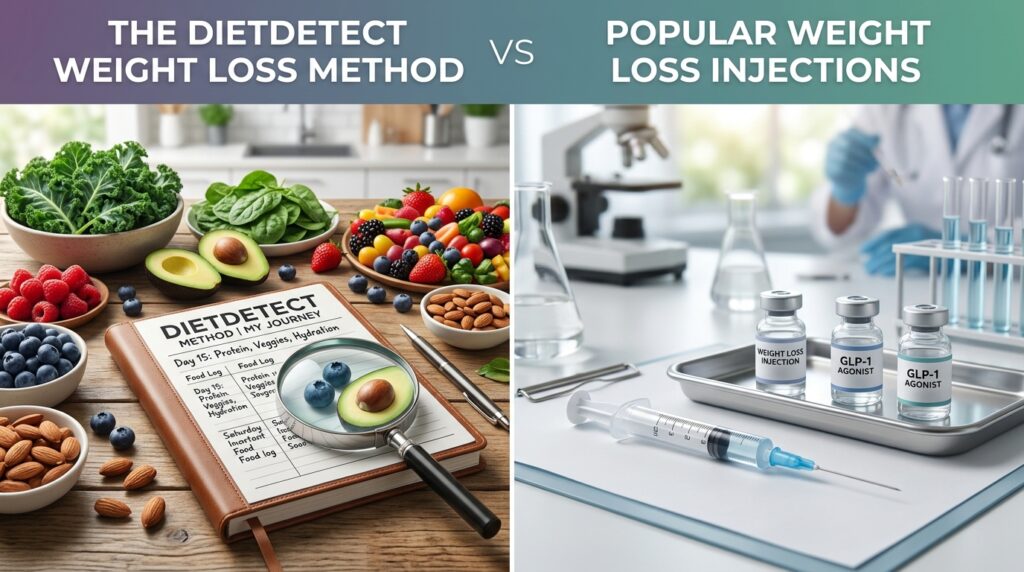
If you’ve spent any time on social media lately, you’ve probably seen it: someone’s “before and after,” a syringe, and a caption about how Ozempic or Wegovy changed their life. Weight loss injections have become the most talked-about topic in health and wellness in the last few years and for good reason. They work. People lose real weight, sometimes fast.
But here’s the question nobody’s really answering honestly: what happens after?
I’ve spent a lot of time researching both sides of this conversation the pharmacology of GLP-1 injections and the behavioral science behind sustainable calorie and nutrition tracking. What I’ve found is that these two approaches aren’t really competitors. They’re solving different parts of the same problem. And understanding that difference is the key to actually keeping weight off, not just losing it.
Quick Answer: The TL;DR
Weight loss injections suppress appetite chemically. The DietDetect method builds awareness and habits around what you actually eat. One works on your biology; the other works on your behavior. The most successful long-term results whether you’re on an injection or not almost always come back to one unavoidable fact: you need to understand your calories and nutrition to keep the weight off.
Let’s get into why.
How Weight Loss Injections Actually Work
GLP-1 receptor agonists the drug class behind Ozempic, Wegovy, Mounjaro, and Zepbound were originally developed for type 2 diabetes. They work by mimicking a hormone your gut releases after eating, which slows digestion, increases feelings of fullness, and reduces appetite signals from the brain.
Clinical trials have shown meaningful weight loss with these medications often in the range of 15-20% of body weight over 68 weeks for semaglutide, and higher for tirzepatide in some studies. That’s genuinely significant, and it’s why these drugs have exploded in popularity.
But here’s what doesn’t always make it into the Instagram captions:
- They’re expensive. Without insurance coverage, monthly costs can run several hundred to over a thousand dollars.
- Side effects are common. Nausea, vomiting, constipation, and in some cases more serious gastrointestinal issues are frequently reported.
- Weight often returns after stopping. Multiple studies have found that a significant portion of lost weight comes back within a year of discontinuing the medication, unless nutrition and lifestyle habits change alongside it.
- They don’t teach you anything. The injection doesn’t tell you that your “healthy” smoothie has 600 calories, or that you’re eating way less protein than your body needs to preserve muscle while losing fat.
That last point is the one I think matters most, and it’s exactly where the conversation shifts.
Why Calories and Nutrition Still Run the Whole Show
Here’s a truth that doesn’t change no matter what tool, drug, or method you use: weight loss and weight maintenance are governed by energy balance. Calories in versus calories out. Weight loss injections don’t rewrite this law of physiology they just make it easier to eat less by reducing hunger.
That’s genuinely useful for a lot of people. But appetite suppression without nutritional awareness can backfire in quiet ways:
- People on GLP-1s often eat so little that they under-consume protein, which accelerates muscle loss alongside fat loss a problem several obesity researchers have flagged as a real concern with rapid weight loss drugs.
- Without visibility into what they’re eating, some people unknowingly stay in a nutrient deficit even while losing weight, leading to fatigue, hair thinning, or low energy.
- Once appetite returns to normal (on a lower dose, or after stopping), old eating patterns tend to resurface because they were never actually addressed, just muted.
This is the gap the DietDetect method is built to fill.
The DietDetect Method: Awareness Before Restriction
DietDetect isn’t a diet. It’s not a drug. It’s a way of finally seeing what you’re eating, clearly and without judgment, so you can make decisions based on real information instead of guesswork.
The method is simple:
- Log it your way. Snap a photo of your meal, or just describe it in plain language “grilled chicken bowl with rice and veggies” and DietDetect estimates the calories and nutritional breakdown for you. No manual searching, no barcode scanning marathons.
- See the full picture. Beyond calories, you get a breakdown of protein, carbs, fats, and key nutrients the stuff that actually determines whether your body is losing fat, preserving muscle, or just losing water weight.
- Track the pattern, not just the day. The history and calendar feature lets you look back at a week, a month, or longer, so you’re not obsessing over one meal you’re watching the trend that actually predicts results.
- Use the analytics to adjust. Instead of guessing whether you’re “eating healthy,” you can actually see it where your calories are coming from, whether your protein is on track, and whether your habits over time match your goals.
The philosophy behind this is simple: you can’t manage what you can’t measure, but measuring shouldn’t feel like a chore. That’s why the photo and description logging exists most people quit calorie tracking not because it doesn’t work, but because typing every ingredient into an app for every meal is exhausting. Removing that friction is the whole point.
A Case Study: Two Paths, One Goal
Consider two people, both starting at a similar weight and goal.
Person A starts a GLP-1 injection. Within three months, appetite drops significantly, and they lose 18 pounds without much conscious effort. It feels almost effortless until they start noticing they’re low on energy during workouts, and a routine check-in with their doctor shows some muscle loss alongside the fat loss. They realize they’ve been eating the same three low-effort meals a day because eating simply doesn’t interest them anymore, and those meals are carb-heavy and protein-light.
Person B starts using a calorie and nutrition tracking method snapping pictures of meals, checking their analytics weekly. Weight loss is slower at first, closer to 6-8 pounds in three months, because there’s no appetite suppression doing the heavy lifting. But by month four, patterns emerge: they notice their weekday breakfasts are nutritionally weak, they adjust, and their protein intake steadily climbs. By month six, their fat loss has accelerated because their nutrition finally supports it, and they’ve built a habit that doesn’t depend on a prescription refill.
Neither path is “wrong.” But Person B’s results are self-sustaining. Person A’s likely aren’t not without adopting the same tracking habits Person B started with from day one.
This is why, increasingly, doctors and dietitians recommend combining GLP-1 medications with nutrition tracking rather than treating the injection as a standalone solution. The drug handles appetite; tracking handles awareness. Neither replaces the other.
Why This Isn’t an “Either/Or” Debate
I want to be upfront about something: if you’re using or considering a weight loss injection, that’s a decision between you and your doctor, and it can be a genuinely effective tool for people who need it, especially those managing obesity-related health risks. This post isn’t here to talk anyone out of that.
What it is here to say is this: no injection, no drug, and no method replaces understanding your own nutrition. Whether you’re on medication or not, the people who keep weight off long-term are almost always the ones who understand what “calories in” actually looks like on their plate not as a punishment, but as information.
That’s the entire premise DietDetect is built on. It’s not about restriction. It’s not about guilt. It’s about finally being able to see your eating patterns clearly enough to make small, sustainable adjustments the kind that actually stick, with or without a prescription.
The Bottom Line
Weight loss injections can change your appetite. Tracking your calories and nutrition changes your relationship with food. One is chemical. The other is behavioral. And behavioral change is what determines whether weight loss becomes permanent or temporary.
If you’re exploring GLP-1 medications, pairing them with a simple tracking habit can help protect your muscle mass, keep your nutrition balanced, and prepare you for life after the prescription. And if you’re not on medication at all or aren’t sure it’s right for you building that awareness might be the only tool you actually need.
Ready to see what your eating patterns actually look like? Download DietDetect, snap a photo of your next meal, and let the numbers tell you the story your appetite never could.