

I used to think “eat more fiber” was one of those throwaway pieces of advice right up there with “drink more water” and “get more sleep.” True, but useless, because nobody tells you how much, from where, or why it actually moves the needle on digestion or the scale.
That changed for me about three years ago, during a stretch where I was bloated almost every afternoon, snacking constantly, and never quite full after meals. A dietitian friend looked at what I was eating protein shakes, white rice, chicken breast, almost no plants and said, “You’re eating like someone trying to lose weight in 2009. You’re getting maybe 9 grams of fiber a day. You need closer to 30.”
That one conversation sent me down a rabbit hole of nutrition research, food logs, and a lot of lentils. This post is what I wish someone had handed me back then: a straight answer on the best high fiber foods, what they actually do for digestion and weight loss, and how to fit them into a normal life without becoming “that person” who brings flax seeds to brunch.
Why Fiber Actually Matters (Not Just “Good For You”)
Fiber is the part of plant food your body can’t fully digest. Instead of being broken down and absorbed like sugar or fat, it passes through your gut mostly intact and that’s exactly why it’s so powerful.
There are two types, and they do different jobs:
- Soluble fiber dissolves in water and forms a gel-like substance. It slows digestion, helps regulate blood sugar, and lowers cholesterol. Found in oats, beans, apples, and citrus fruits.
- Insoluble fiber doesn’t dissolve. It adds bulk to stool and helps food move through your digestive tract efficiently. Found in whole grains, nuts, and vegetable skins.
Most whole foods contain a mix of both, which is part of why “eat whole foods” keeps beating “take a fiber supplement” in study after study.
For digestion specifically, fiber:
- Feeds beneficial gut bacteria (it’s literally their food source)
- Softens and bulks stool, reducing constipation
- Reduces bloating over time by supporting a balanced gut microbiome
- Lowers risk of diverticular disease and, per long-term studies, colorectal cancer
For weight loss, fiber works less like a magic fat-burner and more like a quiet accomplice:
- It slows gastric emptying, so you feel full longer on fewer calories
- Fiber-rich foods tend to have lower calorie density (more volume, fewer calories per bite)
- It blunts blood sugar spikes, which means fewer energy crashes and less snacking
- Some fiber (especially viscous soluble fiber) may reduce how many calories from fat and protein your body actually absorbs
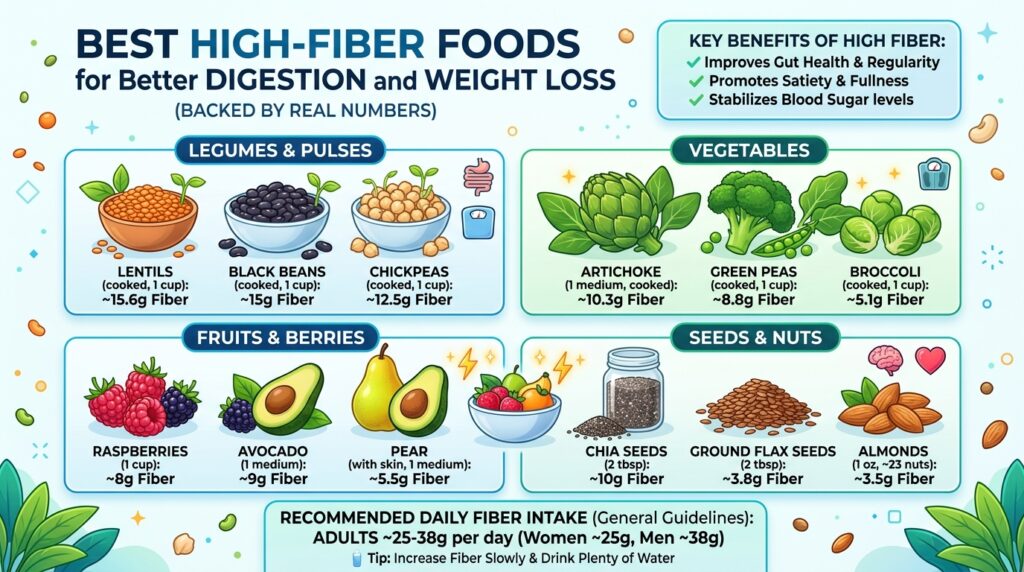
The general recommendation from most dietary guidelines is 25 grams a day for women and 38 grams for men, though many nutrition researchers now suggest higher targets up to 40–50 grams for people who want fiber’s full metabolic benefits. Most people eating a standard Western diet get less than half that.
The Best High Fiber Foods (With Real Fiber and Calorie Numbers)
Here’s where most articles get vague. I wanted numbers, so I pulled together fiber and calorie data for the foods I actually eat, based on standard nutrition databases. All values are per typical serving, not per 100g, because that’s how you’ll actually eat them.
Legumes (the fiber heavyweights)
- Lentils, cooked (1 cup): ~230 calories, 15.6g fiber
- Black beans, cooked (1 cup): ~227 calories, 15g fiber
- Chickpeas, cooked (1 cup): ~269 calories, 12.5g fiber
- Split peas, cooked (1 cup): ~231 calories, 16.3g fiber
Legumes give you the best fiber-to-calorie ratio of almost any food group, plus real protein which is why a lentil soup fills you up in a way that 230 calories of crackers never will.
Whole Grains
- Oats, dry (1/2 cup): ~150 calories, 4g fiber (soluble-heavy, great for cholesterol)
- Quinoa, cooked (1 cup): ~222 calories, 5.2g fiber
- Barley, cooked (1 cup): ~193 calories, 6g fiber
- Whole wheat pasta, cooked (1 cup): ~174 calories, 6.3g fiber
Vegetables
- Artichoke, cooked (1 medium): ~64 calories, 10.3g fiber (an underrated fiber champion)
- Broccoli, cooked (1 cup): ~55 calories, 5.1g fiber
- Brussels sprouts, cooked (1 cup): ~56 calories, 4g fiber
- Sweet potato with skin (1 medium): ~112 calories, 3.8g fiber
Fruits
- Raspberries (1 cup): ~64 calories, 8g fiber
- Pear with skin (1 medium): ~101 calories, 5.5g fiber
- Apple with skin (1 medium): ~95 calories, 4.4g fiber
- Avocado (1/2 medium): ~120 calories, 5g fiber (plus healthy fats that slow digestion further)
Nuts and Seeds
- Chia seeds (1 oz / 2 tbsp): ~138 calories, 9.8g fiber
- Almonds (1 oz, ~23 almonds): ~164 calories, 3.5g fiber
- Flaxseed, ground (2 tbsp): ~75 calories, 4g fiber
A pattern jumps out once you line these up: legumes and artichokes give you the most fiber per calorie, while nuts and seeds are calorie-dense but nutritionally efficient in small amounts. Knowing this changes how you build a plate swap half your rice for lentils, add chia to your yogurt, snack on raspberries instead of chips and the fiber total climbs fast without you “trying” all day.
A Quick Case Study: What Changed When I Actually Tracked It
After that conversation with my dietitian friend, I didn’t overhaul my diet overnight. I made three swaps:
- Replaced my white rice side with lentils or black beans most days
- Added a tablespoon of chia seeds to my morning oats
- Started eating fruit with skin on instead of peeling everything
Within about two weeks, the afternoon bloating I mentioned earlier had mostly disappeared. Within six weeks, I noticed I was naturally eating less at dinner not because I was restricting, but because lunch actually kept me full. Over four months, without counting calories obsessively, I lost about 9 pounds. The fiber wasn’t a diet; it was a mechanism that made the diet I was already trying to follow actually work.
The part that made the biggest difference, honestly, wasn’t the food it was seeing the numbers. Once I could see that a lentil-based lunch had three times the fiber of my old sandwich for fewer calories, the swaps stopped feeling like sacrifices and started feeling like upgrades.
That’s actually the exact gap Diet Detect was built to close. Instead of manually looking up fiber and calorie counts (which is what I was doing with spreadsheets for months), you just snap a picture of your meal or describe what you ate, and it logs the calories and nutrition fiber included automatically. It keeps a history calendar so you can look back and see, like I eventually did, that the weeks with more lentils and less bloating aren’t a coincidence. The analytics view is what made the pattern obvious to me faster than my own trial-and-error ever could.
How Much Fiber Do You Actually Need, and How Fast Should You Add It?
If you’re currently eating a low-fiber diet, don’t jump from 10 grams to 40 grams overnight. A sudden increase in fiber especially without enough water commonly causes gas, cramping, and bloating, which is exactly the opposite of what you’re going for.
A more sustainable approach:
- Week 1–2: Add one high-fiber food per meal (a piece of fruit, a side of beans, swap white bread for whole grain)
- Week 3–4: Aim for 20–25 grams a day total
- Week 5 onward: Build toward 30–38 grams, adjusting based on how your gut responds
- Throughout: Increase water intake alongside fiber fiber needs water to do its job in your colon, and without it, constipation can actually get worse, not better
Everyone’s gut responds a little differently, which is part of why generic meal plans often fail. This is another place where actually tracking what you eat for a couple of weeks is more useful than following a template you can see which high fiber foods you tolerate well and which ones cause more bloating than benefit, and adjust accordingly. Diet Detect’s calendar view is useful here too, since you can flag how you felt on days with different fiber sources and start noticing your own patterns.
Expert and Research-Backed Notes Worth Knowing
- A well-known long-term study following participants for over 40 years found that higher fiber intake was associated with lower risk of death from cardiovascular disease, colorectal cancer, and diabetes-related causes.
- Registered dietitians generally recommend getting fiber from whole foods rather than supplements first, because whole foods bring along resistant starches, polyphenols, and micronutrients that isolated fiber powders don’t replicate.
- Soluble fiber in particular (oats, beans, apples) has consistently shown LDL-cholesterol-lowering effects in clinical research, which is part of why it’s recommended so often for heart health, not just digestion.
- Fiber’s fullness effect is partly mechanical (bulk and slowed emptying) and partly hormonal fiber fermentation in the colon produces short-chain fatty acids that influence hunger hormones like GLP-1.
None of this means fiber is a silver bullet. If you eat 40 grams of fiber a day but your total calorie intake is far above what you burn, you won’t lose weight fiber supports the process, it doesn’t override the fundamentals of energy balance. That’s exactly why pairing high fiber foods with actual calorie awareness (not obsessive counting, just knowing) tends to produce better results than either one alone.
A Simple High-Fiber Day (For Reference)
- Breakfast: Oats with chia seeds and raspberries ~290 calories, ~14g fiber
- Lunch: Lentil and vegetable soup with a pear ~380 calories, ~13g fiber
- Snack: Apple with a small handful of almonds ~260 calories, ~8g fiber
- Dinner: Grilled salmon, quinoa, roasted broccoli ~520 calories, ~9g fiber
Total: roughly 1,450 calories, 44 grams of fiber above the general recommendation, without a single “diet food” in sight.
Frequently Asked Questions
Can too much fiber cause bloating? Yes, especially if you increase intake quickly or don’t drink enough water. Add fiber gradually and stay hydrated.
Is fiber more important than protein for weight loss? They serve different roles. Protein preserves muscle and boosts satiety through a different mechanism; fiber slows digestion and feeds gut bacteria. The best results tend to come from having enough of both, not choosing one over the other.
Do fiber supplements work as well as high fiber foods? They can help close a gap, but whole foods generally outperform supplements because of the additional nutrients and compounds that come along with them.
What’s the easiest way to eat more fiber without a big diet overhaul? Swap refined grains for whole grains, add one serving of legumes a day, and leave the skin on fruits and vegetables when possible. Small swaps compound faster than people expect.