

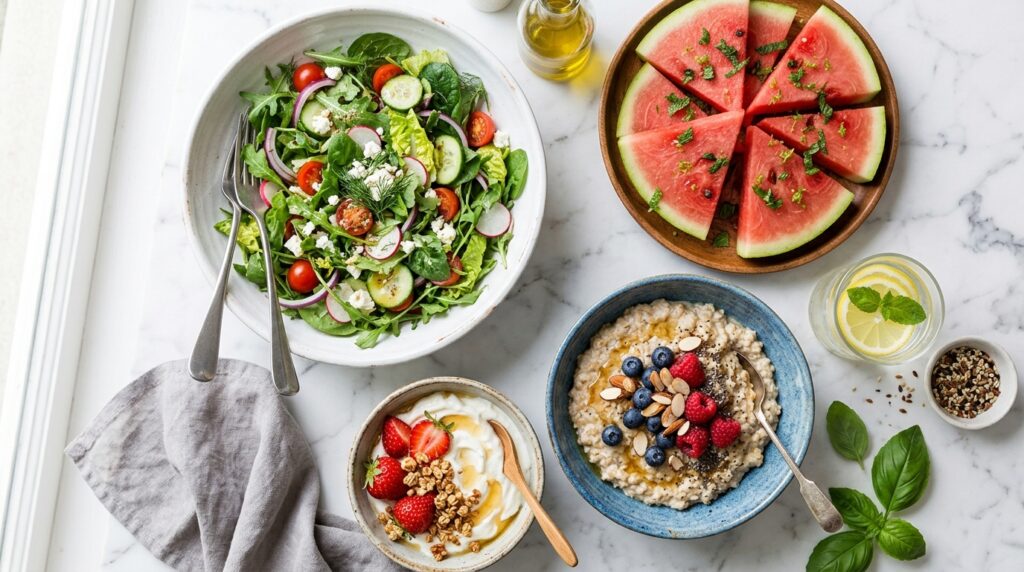
If you’ve ever eaten a 100-calorie granola bar and felt hungry again twenty minutes later, you already know the truth: calories and fullness are not the same thing.
This is the single biggest mistake people make when they try to eat “light.” They assume low calorie automatically means satisfying. It doesn’t. A food’s calorie count tells you how much energy it has it tells you almost nothing about how long that food will actually keep hunger away. That gap is exactly why so many diets fail by 3 p.m.
I’ve spent a lot of time looking at this from both the nutrition side and the data side (which is also, full disclosure, why I help build Diet Detect, an app that tracks exactly this kind of thing). And the pattern is consistent: people don’t overeat because they lack discipline. They overeat because they keep choosing foods that are technically “low calorie” but biologically forgettable.
Let’s fix that.
Why “Low Calorie” Isn’t the Same as “Filling”
In 1995, researcher Susanna Holt and her team at the University of Sydney ran a now-famous experiment. They fed volunteers 38 different foods, all at the exact same calorie amount, and then tracked how hungry people felt every 15 minutes for two hours. The result was the Satiety Index and it blew up the idea that all calories are interchangeable.
Boiled potatoes, for example, kept people full more than three times longer than white bread at the same calorie level. Croissants and candy bars, despite being calorie-dense, barely registered on the fullness scale at all. Fish and oatmeal also scored extremely high.
What separates a filling food from a forgettable one usually comes down to four things:
- Protein content Protein triggers a stronger and longer hormonal fullness response (via hormones like GLP-1, CCK, and PYY) than almost any other nutrient. Gram for gram, researchers estimate it’s roughly two to three times more satiating than fiber.
- Fiber content Fiber slows digestion, feeds your gut bacteria, and physically takes up space in your stomach. It’s a slower-burning fullness signal than protein, but it stacks well with it.
- Water content Foods with high water content (think soups, vegetables, fruit) add volume and weight without adding many calories. Your stomach has stretch receptors that signal fullness based partly on volume, not just energy content.
- How solid it is This one surprises people. Liquid calories digest two to three times faster than solid food and largely bypass the mechanical “stretch” signals that tell your brain you’re full. A 400-calorie smoothie will rarely fill you up the way a 400-calorie plate of food does, even with similar ingredients.
This is the actual science behind “eating clean” it’s not about virtue, it’s about which foods talk to your hunger hormones the loudest for the fewest calories.
The Best Low Calorie, High Satiety Foods
Here’s a practical list built around foods that score well across protein, fiber, water content, and volume without costing you many calories.
1. Potatoes (boiled or baked, not fried)
Potatoes have an undeserved bad reputation. Boiled potatoes topped the original Satiety Index study by a wide margin. They’re roughly 80–90 calories per 100g, mostly water and resistant starch, and genuinely hard to overeat compared to fries or chips made from the same vegetable.
2. Eggs
Around 70 calories each, eggs are one of the most efficient protein-to-calorie foods you can eat. Several studies on egg-based breakfasts show people eating less at their next meal compared to a calorie-matched bagel or cereal breakfast.
3. Greek Yogurt (plain, not flavored)
Roughly 100 calories per 100g with double the protein of regular yogurt. The combination of protein and slow-digesting casein makes it one of the better snack options for staying full between meals.
4. Lentils and Beans
Around 115–130 calories per 100g cooked, with a rare combination of high protein and high fiber in the same food. This is part of why legume-heavy diets consistently perform well in satiety research.
5. Leafy Greens and Cruciferous Vegetables
Spinach, kale, broccoli, and cauliflower are extremely low in calories (20–35 per 100g) but high in volume, fiber, and water. They’re the easiest way to make a meal physically bigger without making it more caloric.
6. Oats
A 300-calorie bowl of oatmeal regularly ranks near the top of satiety studies, partly thanks to a soluble fiber called beta-glucan, which slows stomach emptying and blunts blood sugar spikes.
7. Soups (broth-based, not cream-based)
A bowl of broth-based vegetable or chicken soup is mostly water, which adds volume and weight to a meal for very little energy. Multiple studies have found that starting a meal with soup reduces total calories eaten afterward a phenomenon nutrition researchers sometimes call the “volumetrics” effect.
8. White Fish and Chicken Breast
Lean protein with minimal fat. Fish actually scored second-highest in the original Satiety Index, behind only boiled potatoes.
9. Cottage Cheese
Around 90–110 calories per 100g with a high proportion of slow-digesting casein protein, which keeps amino acids trickling into your bloodstream for hours.
10. Apples and Oranges (whole, not juiced)
Whole fruit retains its fiber and requires chewing, both of which slow down how fast you eat and how fast the calories hit your system. Juicing removes the fiber and turns the same fruit into a fast-digesting liquid.
11. Air-Popped Popcorn
Roughly 30 calories per cup, mostly air and fiber. The volume-to-calorie ratio is one of the best of any snack food.
12. Edamame and Chickpeas
Plant protein and fiber together again roughly 120–165 calories per 100g, and far more filling than most “low calorie” packaged snacks at the same calorie count.
The Pattern Behind All of These
Notice none of these are “diet” products. None of them are 90-calorie snack packs or “skinny” anything. They’re whole, minimally processed foods that are naturally low in calorie density while being high in protein, fiber, or water. That’s not a coincidence it’s the actual mechanism. Processed low calorie foods are usually engineered to taste good per bite, not to fill you up per calorie. Whole foods tend to do the opposite.
Why This Actually Matters (Beyond the Number on a Label)
Here’s the part most “what to eat” lists skip: knowing this list doesn’t help much if you don’t know what you’re actually eating day to day. A few real patterns I’ve seen come up again and again:
- Someone eats a “healthy” smoothie for breakfast, feels hungry by 10 a.m., and doesn’t connect the two because they never tracked that the smoothie was mostly fruit juice and almond milk with very little protein.
- Someone swaps regular bread for a “light” bread to cut calories, but the light bread has less fiber and protein per slice, so they end up eating two extra slices later in the day to feel satisfied net result: more calories, not fewer.
- Someone eats plenty of vegetables but very little protein, and wonders why they’re constantly snacking by evening even though their calorie total looks fine on paper.
In every one of these cases, the problem wasn’t a lack of willpower. It was a lack of visibility into what was actually in the food, not just how many calories it had.
This is exactly the gap Diet Detect is built to close. Instead of manually logging every ingredient, you just snap a photo of your plate or describe what you ate in plain language, and it breaks down the calories and nutrition for you protein, fiber, fat, the works. Over time, your history calendar shows you the days you genuinely felt full versus the days you didn’t, and the analytics make it pretty obvious why: it’s almost always a protein or fiber gap, not a “you ate too much” problem.
You don’t need to memorize a satiety index or do math at every meal. You just need to see the pattern in your own eating, once, and you tend to remember it.
A Simple Way to Build a “Full Longer” Plate
If you don’t want to overthink it, use this rough framework for most meals:
- Base: A lean protein (eggs, fish, chicken, lentils, cottage cheese, Greek yogurt)
- Volume: A large portion of vegetables or a broth-based soup
- Slow carb: A small portion of potatoes, oats, or whole grains rather than refined ones
- Skip: Liquid calories as a meal replacement drink water, eat your calories
This isn’t a rigid diet. It’s just stacking the four satiety factors protein, fiber, water, and solidity into a normal meal instead of fighting hunger with restriction.
The Real Takeaway
Low calorie doesn’t automatically mean low hunger. The foods that genuinely keep you full longer share a few specific traits high protein, high fiber, high water content, and minimal processing and the science behind why has been documented for decades, not guessed at.
The fastest way to find out which of these patterns apply to your own diet isn’t another list. It’s actually seeing what’s in your meals over time. That’s the whole idea behind Diet Detect: snap a photo, log a description, and let the calendar and analytics show you where your fullness is actually coming from so the next “low calorie” meal you choose is one that actually works.
About the Diet Detect App: Diet Detect lets you track calories and nutrition by simply snapping a picture of your food or describing it in your own words. It automatically logs your history on a calendar and gives you analytics on your eating patterns over time so you can see, not just guess, what’s actually keeping you full.
Frequently Asked Questions
What are the best low calorie foods that keep you full the longest? Boiled potatoes, fish, oats, eggs, lentils, Greek yogurt, and leafy greens consistently rank highest in satiety research relative to their calorie count, mainly due to their protein, fiber, and water content.
Why do some low calorie foods still leave you hungry? Many packaged “low calorie” foods are low in protein and fiber and high in refined carbs or liquid calories, which digest quickly and don’t trigger strong fullness hormones.
Is tracking calories alone enough to stay full and lose weight? Not really. Tracking the type of calories protein, fiber, water content matters as much as the total. This is why nutrition breakdowns, not just calorie counts, matter for staying full.
How can I find out which foods keep me full without guessing? Logging your meals with a tool like Diet Detect and reviewing your history and analytics over a few weeks usually reveals the pattern clearly most people find a consistent protein or fiber gap on the days they felt hungriest.
site: mydietdetect.com