

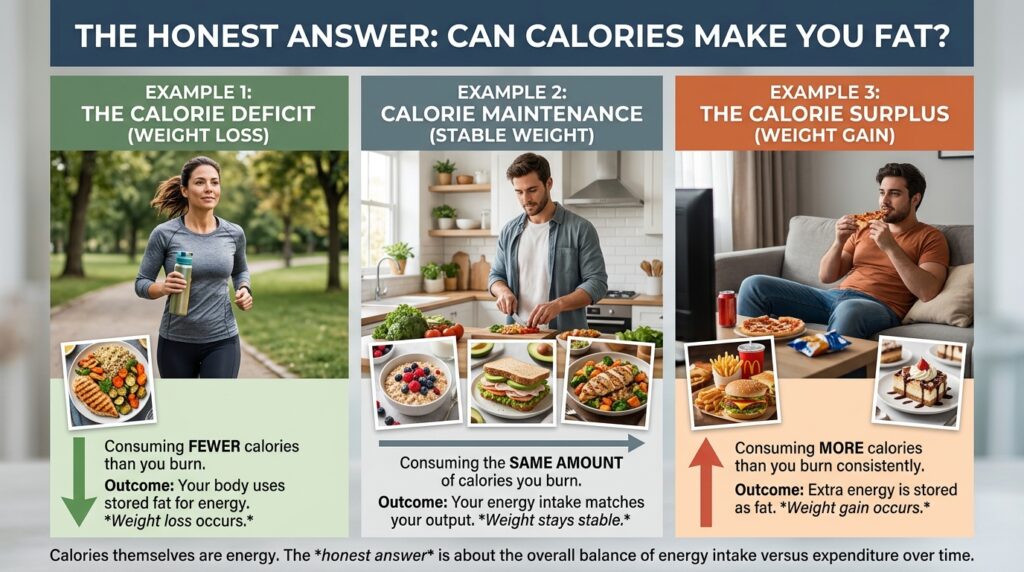
Let’s start with the question everyone is really asking but nobody wants to answer straight: yes, calories can make you fat. But that single sentence, without context, has probably done more harm to people’s relationship with food than almost anything else in nutrition history.
So let’s actually talk about it the science, the nuance, the stuff the fitness world glosses over, and what real people experience when they start paying attention to what they eat.
The Science (Without Making Your Eyes Glaze Over)
Your body runs on energy. That energy comes from food, measured in calories. When you consistently take in more energy than your body uses, the excess gets stored primarily as fat. This is called a caloric surplus, and it’s the fundamental mechanism behind fat gain.
This part is not controversial. It’s basic thermodynamics, and it holds up.
But here’s where it gets complicated: your body is not a simple machine.
Two people can eat the exact same number of calories and have completely different outcomes. One person gains weight, another doesn’t. Why? Because calories are just one variable in a system that includes your metabolism, hormone levels, sleep quality, stress, gut microbiome, how processed your food is, and even how fast you eat.
So the more accurate answer is: a chronic caloric surplus causes fat gain but what drives that surplus is deeply personal.
The Part Nobody Talks About: Why People End Up in a Surplus
Most people aren’t consciously trying to overeat. They’re busy, stressed, tired, and making food decisions dozens of times a day under conditions that aren’t exactly ideal for thoughtful nutrition.
Here’s what typically happens:
You underestimate portion sizes. Research consistently shows that people including nutrition professionals significantly underestimate the calories in their meals. A “handful” of nuts, a “splash” of olive oil, a “small” bowl of pasta. These add up fast, and our brains aren’t wired to naturally track this with accuracy.
You eat differently on weekends than weekdays. Many people eat reasonably well Monday through Thursday, then have two or three days of higher-calorie eating that erases the deficit. It doesn’t feel like overeating because it’s spread across “fun” meals and social situations.
Liquid calories go unnoticed. A large flavored coffee drink, a glass of juice, a couple of beers these can add 400–800 calories to a day without registering as “eating” in your brain.
Stress and sleep deprivation increase hunger hormones. Cortisol and ghrelin (your hunger hormone) both rise when you’re sleep-deprived or stressed, making you genuinely hungrier and more drawn to calorie-dense foods. Your willpower isn’t the problem your biology is working against you.
A Real Example: Sarah’s Story
Sarah is 34, works a desk job, and by all accounts eats “pretty healthy.” She doesn’t eat fast food. She cooks at home most nights. She doesn’t drink much. But over five years, she’d slowly gained about 12 kg and couldn’t figure out why.
When she started actually tracking what she ate for two weeks not to restrict, just to observe she was surprised. Her homemade smoothies were around 500 calories each. Her “light” lunches at the office averaged 700. Her evening snacking after dinner, which she barely registered consciously, was another 300–400 calories.
She wasn’t eating badly. She just had no clear picture of the total. Her daily intake was sitting around 2,400–2,600 calories, while her body was burning closer to 1,900.
That gap 500 to 700 calories a day explained everything.
Sarah didn’t need to diet aggressively. She just needed visibility.
But Wait Are All Calories the Same?
No. And this matters a lot.
200 calories of chicken breast and 200 calories of a cookie have the same energy value on paper, but they behave very differently in your body:
- Protein is highly satiating and requires more energy to digest (the thermic effect of food). You feel full longer and burn more calories processing it.
- Fiber-rich foods slow digestion, stabilize blood sugar, and reduce the likelihood of overeating later.
- Ultra-processed foods are engineered to be hyper-palatable they’re specifically designed to override your natural satiety signals and make you eat more than you need.
So a diet of 2,000 calories from whole foods will almost always leave you more satisfied, more nourished, and less likely to overeat tomorrow than a diet of 2,000 calories from processed snacks even though the number is identical.
This is why “eat less, move more” as advice is technically correct but practically useless for most people. The quality of your calories shapes your hunger, your energy levels, and how hard it is to stay at the right intake in the first place.
The Psychology Nobody Mentions
Here’s something worth saying plainly: the obsession with calories can become its own problem.
There’s a real difference between being informed about what you eat and being anxious about every bite. Chronic dieters often develop an all-or-nothing relationship with food they’re either “on plan” or they’ve blown it, and when they’ve blown it, they might as well eat everything in sight until Monday.
That psychological cycle contributes to weight gain more than many people realize.
The goal isn’t to count calories forever. The goal is to understand your eating patterns well enough that you can make intentional choices without feeling controlled by food or controlling food to the point where it controls you.
What Actually Helps: The Case for Awareness Over Restriction
The people who tend to have the best long-term relationship with their weight aren’t usually the ones who’ve tried the most diets. They’re the ones who developed genuine awareness of what they eat, why they eat it, and what their body actually needs.
That awareness doesn’t have to be obsessive or complicated. It can be as simple as:
- Knowing roughly what you ate yesterday
- Noticing when you’re eating because you’re hungry vs. bored or stressed
- Recognizing patterns like always overeating on Thursday nights, or always skipping meals when you’re overwhelmed
- Seeing how your choices change across the week, not just in one perfect day
This is exactly the kind of pattern recognition that tools like Diet Detect make genuinely accessible. Instead of manually logging every gram of food (which most people abandon after a week), you can just take a photo of your meal or briefly describe what you ate, and the app fills in the nutritional details for you. Over time, the history calendar and analytics show you the patterns you can’t see in the day-to-day the weekly trends, the calorie creep, the areas where small adjustments could make a real difference without any dramatic overhaul of your diet.
It’s not about obsessing. It’s about finally having a clear picture of something that was previously invisible.
So Can Calories Make You Fat?
Yes. A consistent surplus of calories, sustained over time, leads to fat gain. That’s real, and pretending otherwise doesn’t help anyone.
But calories alone don’t tell the whole story. The quality of the food matters. Your hormones and sleep matter. Stress matters. The psychological relationship you have with eating matters just as much as the numbers.
The most useful shift isn’t from “eat everything” to “count everything.” It’s from unawareness to awareness understanding what you’re actually eating, why, and what your body is doing with it.
That’s where sustainable change actually lives.
Want to start building that awareness without the stress of manual tracking? Diet Detect lets you log meals with a photo or a quick description making it the easiest way to finally see the patterns in your eating. Available now at www.mydietdetect.com.