

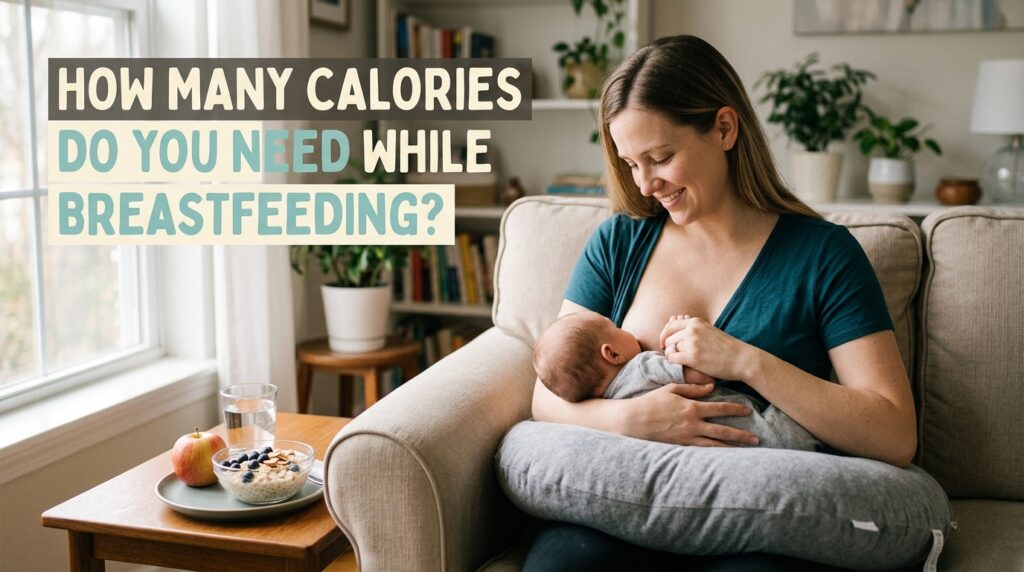
Let me be honest with you for a second.
When I first started breastfeeding, the advice I got was all over the place. “Eat for two.” “Don’t eat too much or you’ll gain weight.” “You can lose weight while breastfeeding if you’re careful.” “Don’t restrict it’ll hurt your supply.”
I was exhausted, sleep-deprived, and genuinely confused. I just wanted to know: how much should I actually be eating?
If you’re asking the same question, you’re in the right place. This post is going to give you the real numbers, the nuance behind them, and honest perspective from dietitians and moms who’ve been there without any of the guilt that usually comes attached to these conversations.
The Short Answer (and Why It’s More Complicated Than You Think)
Most official health guidelines including those from the American College of Obstetricians and Gynecologists (ACOG) and the World Health Organization (WHO) suggest that breastfeeding mothers need approximately 400–500 extra calories per day on top of their pre-pregnancy baseline.
For most women, that puts total daily intake somewhere between 1,800 and 2,500 calories depending on your body size, activity level, and how much you’re nursing.
But here’s the thing: those are starting points, not rules. Your actual needs depend on a dozen factors and understanding them is way more useful than just hitting a number.
Why Breastfeeding Burns More Calories Than You Might Expect
Your body is doing something remarkable. It’s producing between 19 and 30 ounces of milk per day (on average), and that milk is nutritionally dense full of fat, protein, lactose, vitamins, and immune-supporting compounds.
Making all of that requires energy. Specifically, producing one liter of breast milk burns roughly 85 calories in food energy, plus another 400–500 calories drawn from maternal fat stores and dietary intake combined.
This is actually why many new moms feel ravenous in the early weeks. Your body isn’t lying to you. It genuinely needs more fuel.
What the Research Actually Says
A landmark study published in the American Journal of Clinical Nutrition found that the total energy cost of lactation averages around 500 kcal/day but this number shifts significantly depending on:
- Exclusivity Are you exclusively breastfeeding, or supplementing with formula?
- Infant age and appetite A 2-week-old drinks far less than a 4-month-old going through a growth spurt.
- Your own metabolism Women with higher resting metabolic rates will burn through those extra calories faster.
- How much fat you stored during pregnancy Some of those reserves are literally designed to fuel early lactation.
The takeaway? There is no single universal number, and anyone who tells you otherwise is oversimplifying.
The “Don’t Go Below 1,500 Calories” Rule
One thing dietitians and lactation consultants consistently agree on: don’t restrict too aggressively while nursing.
Going below roughly 1,500 calories per day can start to affect your milk supply. Your body is smart when resources get scarce, it prioritizes other bodily functions over milk production. Severe caloric restriction can also leave you fatigued, depleted of key nutrients, and emotionally depleted at an already demanding time.
This doesn’t mean you can’t lose weight while breastfeeding many women do, and it can happen healthily. But aggressive calorie-cutting is not the way.
Practical rule of thumb: Aim for a modest deficit of no more than 300–500 calories below your total needs if weight loss is a goal. Slower is almost always better in the postpartum period.
Real Talk: Three Moms, Three Very Different Experiences
Amira, 31 First-time mom, exclusively breastfeeding
“I lost weight really fast in the first six weeks without even trying. I was eating everything in sight probably 2,400+ calories and still losing. My lactation nurse said it was normal because my body was drawing on pregnancy fat stores. Around month two, the weight loss slowed, but I felt way better physically.”
Amira’s experience is common. The early postpartum period is metabolically unique many women burn fat stores built up during pregnancy, which masks how much they’re actually eating.
Priya, 28 Combination feeding (breast + formula)
“Because I wasn’t exclusively breastfeeding, I wasn’t sure how to adjust my intake. I was eating as if I was nursing 100% of the time, which probably wasn’t right. I wish I’d had a way to actually track what I was consuming versus what I needed.”
Priya raises something important: your calorie needs scale with how much you’re nursing. If you’re combination feeding, your needs will be lower than exclusive breastfeeding roughly proportional to how much of your baby’s intake is coming from you.
Dana, 35 Second-time mom, high activity level
“I run three times a week and I completely underestimated how much I needed to eat. My supply tanked around month three and I couldn’t figure out why. My doctor finally asked me to track my food for a week. I was eating maybe 1,600 calories on run days. Way too low.”
Dana’s story is a cautionary tale for active moms. Exercise increases your calorie needs on top of breastfeeding. On active days, you may need 2,500–2,800+ calories to keep supply steady and energy up.
Calories Aren’t the Whole Story: What You Eat Matters Too
Here’s something that often gets lost in the calorie conversation: quality matters, not just quantity.
Breast milk composition shifts based on your diet. While your body will prioritize getting the basics right regardless of what you eat, certain nutrients are heavily influenced by maternal intake:
- Omega-3 fatty acids (DHA) Critical for infant brain development. Found in fatty fish, walnuts, chia seeds, flaxseed.
- Vitamin D Most breast milk is low in Vitamin D regardless of maternal diet; supplementation is often recommended for infants.
- Iodine Supports thyroid function and infant brain development. Found in dairy, seafood, and iodized salt.
- Choline Important for infant brain health. Found in eggs, meat, and legumes.
- Calcium If you don’t consume enough, your body pulls from your bones. Aim for 1,000 mg/day from dairy, leafy greens, fortified foods, or supplements.
Getting enough of these nutrients within your calorie budget is where thoughtful eating not just eating more really matters.
The Hunger Cue Problem
One of the most overlooked issues with breastfeeding nutrition? Hunger cues get disrupted.
Some breastfeeding moms feel constantly hungry. Others especially in the newborn haze of sleep deprivation and chaos forget to eat entirely. Neither extreme serves you well.
A registered dietitian I spoke with put it this way:
“I see two types of clients postpartum. The ones who eat constantly and feel guilty about it, and the ones who barely eat because they’re ‘too busy’ and then wonder why they’re depleted. The real answer is usually somewhere in the middle consistent, nourishing meals that don’t require a lot of mental overhead.”
This is genuinely hard to do when you’re operating on broken sleep with a newborn demanding your attention. Which is exactly why many moms find it helpful to have a low-friction way of actually keeping track of what they’re eating.
A Sample Day of Eating for a Breastfeeding Mom (~2,200 calories)
This isn’t a meal plan it’s an example of what adequate intake can look like without being obsessive about it.
Breakfast Oatmeal with almond butter, banana, and a sprinkle of chia seeds. Two eggs on the side. Black coffee. ~600 calories
Mid-Morning Greek yogurt with a handful of mixed berries and walnuts. ~300 calories
Lunch Large salad with grilled salmon, avocado, quinoa, and olive oil dressing. ~650 calories
Afternoon Snack Whole grain crackers with hummus and cucumber slices. ~200 calories
Dinner Stir-fried chicken thighs with broccoli, bell peppers, brown rice, and sesame oil. ~600 calories
Evening A glass of whole milk or a small bowl of cottage cheese if still hungry. ~150 calories
Notice what this isn’t: it’s not a diet. It’s real food, eaten regularly, designed to fuel a body doing something physically demanding.
Signs You’re Not Eating Enough
Your body will usually tell you before your supply does. Watch for:
- Extreme fatigue that goes beyond typical new-parent tiredness
- Frequent headaches or dizziness
- Brain fog that’s worse than usual
- Feeling cold all the time
- Mood crashes or heightened irritability
- Dropping milk supply despite frequent nursing
If you’re experiencing several of these, eating more not resting more, not supplementing more is often the first place to look.
Signs You Might Be Overeating
This is less common during exclusive breastfeeding, but worth mentioning for combination feeders or moms whose babies have started solids and reduced nursing frequency:
- Continuing to eat at the peak-breastfeeding level when you’ve significantly reduced nursing sessions
- Not adjusting intake as baby transitions to solids (typically around 6 months)
- Using “I’m breastfeeding” as a blanket justification for not paying any attention to what you eat
Again, this isn’t about guilt. It’s about calibration.
The Postpartum Weight Loss Question (Addressed Honestly)
Let’s talk about the elephant in the room.
Many new moms want to lose the pregnancy weight, and they want to know if breastfeeding helps. The honest answer is: sometimes, for some women, modestly.
Some women lose weight effortlessly while breastfeeding. Others hold onto weight especially in the thighs and hips until they wean. Research suggests this may be partially hormonal (prolactin, the milk-producing hormone, may promote fat retention in some women) and partially just individual variation.
What the research consistently shows:
- Breastfeeding can support gradual, modest postpartum weight loss
- Aggressive caloric restriction while breastfeeding is counterproductive and can backfire
- The best outcomes for both weight and milk supply come from adequate, nutrient-dense eating combined with gradual return to activity not dieting
The postpartum body has just done something extraordinary. It deserves nourishment, not punishment.
How Tracking Can Help (Without Making You Obsessive)
Here’s where I want to be straightforward rather than preachy: tracking your food can be incredibly useful during breastfeeding not to restrict, but to make sure you’re actually eating enough.
A lot of breastfeeding moms genuinely undereat, not because they’re trying to, but because life with a newborn is chaotic and meals get skipped or forgotten. Having a simple, low-effort way to check in on your intake can give you real data instead of guesswork.
This is exactly what the Diet Detect app was built for. Instead of weighing every meal or typing in elaborate nutrition labels, you can just take a photo of what you’re eating and let the app recognize it. It logs your calories and nutrition automatically, shows you patterns over time, and gives you a calendar view so you can spot days where you consistently under-fuel.
There’s no calorie goal the app forces on you, no “you’ve exceeded your limit” warnings designed to make you feel bad. It’s just a mirror real information about what you’re actually eating, so you can make real decisions. If you’re nursing a lot and feeling depleted, that information matters.
You can download it here: [Diet Detect Calorie & Nutrition Tracker]
What a Lactation Dietitian Wants You to Know
I reached out to a registered dietitian who specializes in postpartum and lactation nutrition. Here’s what she emphasized:
“Most of the moms I see are undereating, not overeating. They’re so focused on ‘getting their body back’ that they’re not supporting their body’s current job, which is feeding another human. My first recommendation is almost always the same: eat more whole foods, eat more often, and stop being afraid of fat. Your milk is about 50% fat by calories. You need to eat fat to make it.”
She also pointed out something I hadn’t considered: the mental load of tracking nutrition can feel like one more thing on an already overwhelming list. Her approach with new moms is to keep it simple a general framework, not a rigid system.
Quick Reference: Calorie Needs by Situation
| Situation | Estimated Daily Calorie Need |
|---|---|
| Exclusively breastfeeding, sedentary | ~1,800–2,200 kcal |
| Exclusively breastfeeding, active | ~2,200–2,800 kcal |
| Combination feeding | ~1,800–2,100 kcal |
| Baby on solids, reduced nursing | ~1,700–2,000 kcal |
| Weaned | Return to pre-pregnancy baseline |
These are general estimates. Individual needs vary. Work with a healthcare provider or registered dietitian for personalized guidance.
The Bottom Line
Breastfeeding is nutritionally demanding, and the most common mistake isn’t overeating it’s undereating.
Aim for approximately 400–500 extra calories per day above your pre-pregnancy needs, focus on nutrient-dense foods especially rich in healthy fats, protein, calcium, and omega-3s, and pay attention to what your body tells you.
Don’t go below 1,500 calories. Don’t restrict aggressively. And give yourself permission to actually eat enough to do one of the most physically demanding things a human body can do.
You’ve got this.
If you want a simple, zero-stress way to keep track of what you’re eating without the mental overhead, give Diet Detect a try it’s free to download and built with exactly this kind of real-life use case in mind.