

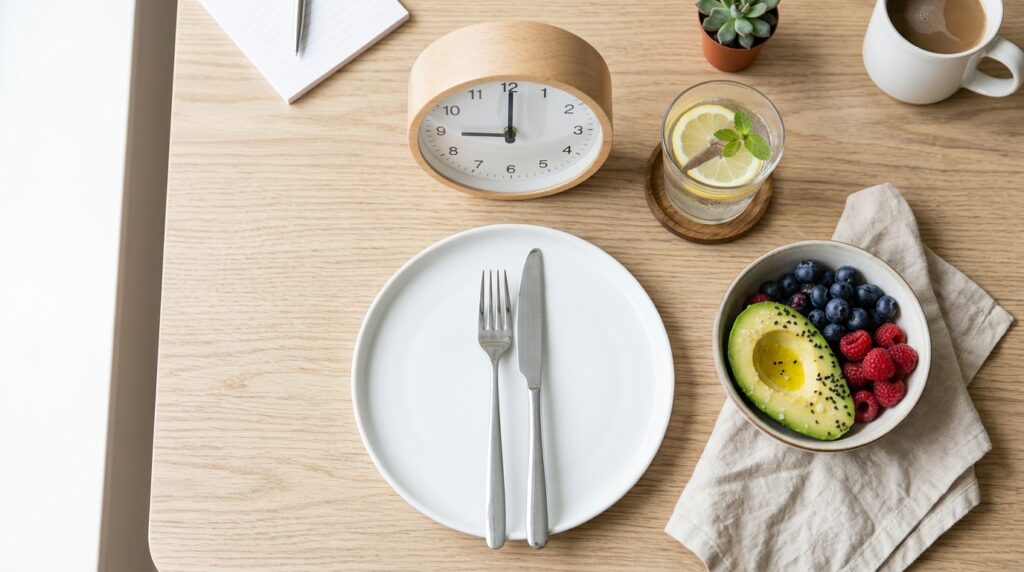
I’ll be honest with you the first time I tried intermittent fasting, I did it completely wrong. I jumped straight into a 20-hour fast because a guy on the internet said it “resets your metabolism.” By hour 14 I was dizzy, irritable, and eating an entire block of cheese standing over the sink at 9 PM. Not exactly the disciplined, glowing-skin transformation I’d pictured.
It took a few more attempts and a lot of trial and error before I found a rhythm that actually worked. So if you’re a beginner trying to figure out where to start, this guide is the one I wish someone had handed me a few years ago.
What Intermittent Fasting Actually Is (and Isn’t)
Intermittent fasting (IF) isn’t a diet in the traditional sense. It doesn’t tell you what to eat it tells you when. You cycle between periods of eating and periods of not eating, and in theory, this gives your body a longer stretch of time to tap into stored energy instead of constantly digesting new food.
Here’s the part a lot of beginners miss, though: fasting windows don’t cancel out calories. If you fast for 16 hours and then eat 3,000 calories of pizza and ice cream in your 8-hour window, you’re not going to lose weight just because you “did IF.” The magic isn’t in the clock it’s in what fasting does to your appetite, your insulin sensitivity, and how much easier it becomes to naturally eat within your calorie needs when you’re not grazing all day.
That’s a big reason I eventually leaned on a food-tracking app instead of guessing. More on that later let’s get to the schedules first.
The Most Beginner-Friendly Intermittent Fasting Schedules
1. The 12:12 Method (Start Here)
Twelve hours fasting, twelve hours eating. If you finish dinner at 8 PM and eat breakfast at 8 AM, you’ve already done this without realizing it. It’s genuinely the best on-ramp because it barely feels different from normal eating, but it starts training your body to associate certain hours with “not eating time.”
Best for: Total beginners, people with a history of disordered eating patterns, anyone nervous about fasting.
2. The 16:8 Method (The Most Popular for a Reason)
Sixteen hours fasting, eight hours eating usually by skipping breakfast and eating between, say, 12 PM and 8 PM. This is the schedule most research and most successful beginners gravitate toward, and in my experience coaching friends through their first month of IF, it has the highest “actually sticks” rate.
Why it works so well: You’re mostly just skipping one meal and sleeping through several fasting hours. It doesn’t require willpower during your most social hours of the day.
Best for: People who want real results without a huge lifestyle disruption.
3. The 18:6 Method
A slightly more advanced version of 16:8 an extra two hours fasted, six hours to eat. I moved to this after about a month on 16:8, once my hunger cues had adjusted. This one demands a bit more meal planning because you have less time to hit your protein and micronutrient targets.
Best for: People who’ve done 16:8 for a few weeks and want to push a bit further.
4. The 5:2 Method
Five days of normal eating, two non-consecutive days where you cap calories around 500–600. This one appeals to people who hate the idea of fasting every single day but are fine with two tougher days a week.
Honest opinion: This is the hardest one for beginners to execute well, because “500 calories” sounds simple until you’re actually trying to hit it without wrecking your nutrient intake. This is a schedule where calorie tracking isn’t optional it’s the whole game.
5. OMAD (One Meal a Day)
Exactly what it sounds like a 23:1 window. I do not recommend this for beginners. It’s aggressive, it’s hard to hit your protein and micronutrient needs in one sitting, and most people who start here burn out within two weeks. Save it for later, if ever.
A Quick Case Study: Sarah’s First 30 Days
A friend of mine, Sarah, wanted to try IF after years of yo-yo dieting. She started on 16:8, cutting breakfast and eating between 11 AM and 7 PM. Her biggest struggle wasn’t the fasting itself it was that she genuinely had no idea whether she was eating enough or too little inside her window. She’d “feel like” she was eating light, then be shocked to see she’d actually hit 2,200 calories from oils, dressings, and snacking she hadn’t mentally counted.
Once she started logging her meals just snapping photos of her plates instead of manually weighing and measuring everything the pattern became obvious almost immediately. She wasn’t undereating. She was under-tracking. Within three weeks of pairing her 16:8 schedule with actual visibility into her calories and macros, her progress became consistent instead of random.
This is genuinely the most common thing I see with beginners: the schedule is the easy part. Knowing what’s actually happening nutritionally inside your eating window is where people get stuck.
Why Calories and Nutrition Still Run the Show
I want to be straightforward with you, because a lot of IF content online oversells the “magic” of the fasting window itself. Fasting can help with:
- Naturally reducing your eating window, which often reduces mindless snacking
- Improving insulin sensitivity over time
- Making calorie deficits feel more manageable for some people (fewer meals to think about)
But it does not override the basics: weight loss still comes down to a sustained calorie deficit, and health outcomes still depend on getting enough protein, fiber, vitamins, and minerals not just eating “on time.” Skipping breakfast and then not paying attention to what you eat for the rest of the day is how people end up frustrated that IF “isn’t working.”
This is exactly the gap where a lot of beginners fall off. They nail the schedule and completely lose track of the nutrition side.
How I’d Actually Approach Your First 2 Weeks
- Week 1: Start with 12:12. Just shift your existing habits slightly no bagel at 7 AM, first bite at 8 AM instead.
- Week 2: Move to 14:10, then 16:8 if it’s feeling manageable. Don’t rush this hunger adaptation takes time.
- From day one, track what you eat inside your window. Not to obsess over it, but to actually see your patterns. This is where I personally lean on the Diet Detect app I just take a photo of my plate or type a quick description like “grilled chicken bowl with rice and veggies,” and it logs the calories and nutrition breakdown for me. No manual weighing, no spreadsheet. It also keeps a history calendar, so I can look back and actually see whether my “light eating days” were real or just a feeling which, like Sarah’s case above, is often the actual problem.
- Watch your protein, not just your calories. Fewer meals means it’s easier to accidentally undereat protein, which matters a lot if you don’t want to lose muscle along with fat.
- Hydrate and don’t fear black coffee or tea during your fasting window they won’t break your fast and can genuinely help with appetite control.
Common Beginner Mistakes
- Starting too aggressive (jumping to 18:6 or OMAD in week one)
- “Reward eating” treating the eating window as a free-for-all because you “earned it”
- Not tracking anything, then being confused about stalled progress
- Ignoring hunger and fullness cues just to stick to a rigid clock
- Under-eating protein because meals are fewer and less planned
My Honest Take
Intermittent fasting isn’t magic, and it isn’t for everyone some people do great with it, others find it makes them irritable or messes with their sleep, and that’s a completely valid reason to try something else. But for a lot of beginners, especially people who tend to snack constantly or lose track of how much they’re really eating throughout the day, a structured window like 16:8 creates just enough boundary to make consistent eating habits easier.
The schedule gets you started. What you actually eat and whether you have any real visibility into it is what determines whether it works long term. That’s the piece most beginner guides skip, and honestly, it’s the piece that made the biggest difference for me.
If you’re starting your own IF journey and want an easy way to see what’s actually happening inside your eating window without logging every gram by hand that’s exactly the kind of day-to-day tracking Diet Detect was built for. Snap a photo or describe your meal, and it handles the rest, so you can spend your energy on the habit, not the math.