

If you have ever looked at a nutrition label, you’ve seen the word. It’s written in bold, sometimes weaponized by fitness influencers, and often treated like a tiny monster that hides in your closet and sews your clothes a little tighter each night.
But what actually is a calorie?
If you ask five different people, you’ll get five different answers. Some say it’s a unit of weight. Others say it’s a measure of health. In reality, it is neither. Let’s break down the actual science, look at how your body handles them, and uncover how managing them can change your relationship with food forever.
The Literal Science: Calories Are Heat
By definition, a calorie is not a physical thing. You cannot pick up a calorie, see it, or drop it on the floor.
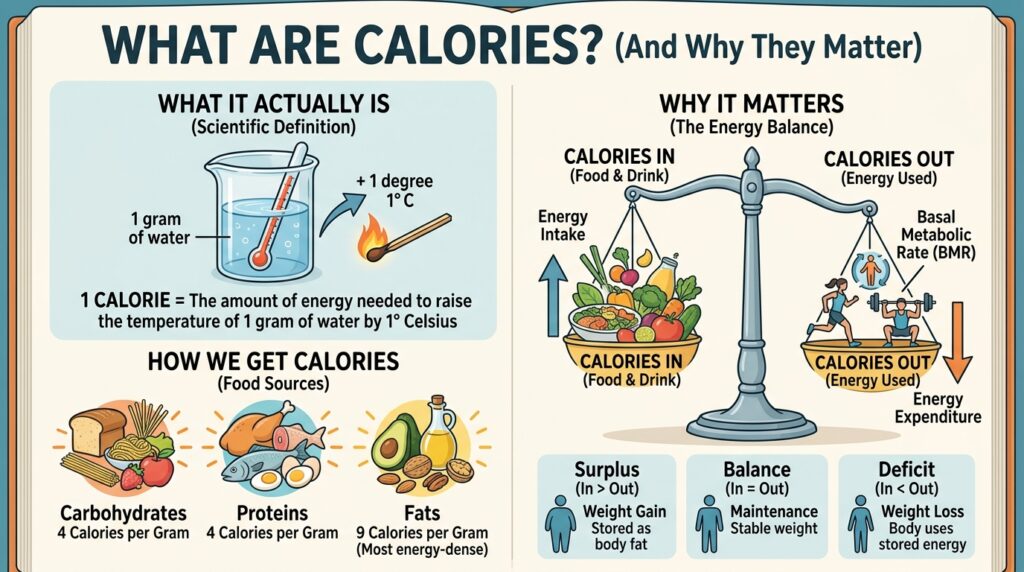
A calorie is a unit of energy. Specifically, one dietary Calorie (with a capital C, also known as a kilocalorie) is the amount of energy required to raise the temperature of 1 kilogram of water by 1°C.
Think of your body like a highly sophisticated engine. Just like a car needs gallons of gasoline to run, your body needs calories of thermal energy to keep your heart beating, your brain firing, and your muscles moving.
How do scientists know how many calories are in an avocado or a slice of pizza?
Historically, they used a device called a bomb calorimeter. They would literally place a food sample inside a sealed container filled with water, burn the food to ash, and measure how much the temperature of the surrounding water rose. If the water warmed up significantly, the food was high in calories.
Today, scientists mostly use the Atwater system, calculating calories by adding up the predefined energy values of the macronutrients inside the food:
- Carbohydrates: 4 calories per gram
- Protein: 4 calories per gram
- Fats: 9 calories per gram
How Your Body Actually Uses Calories
When you eat, your body digests the food and converts these macronutrients into usable energy or stores them for later. The total amount of energy you burn every day is called your Total Daily Energy Expenditure (TDEE). It’s broken down into three main buckets:
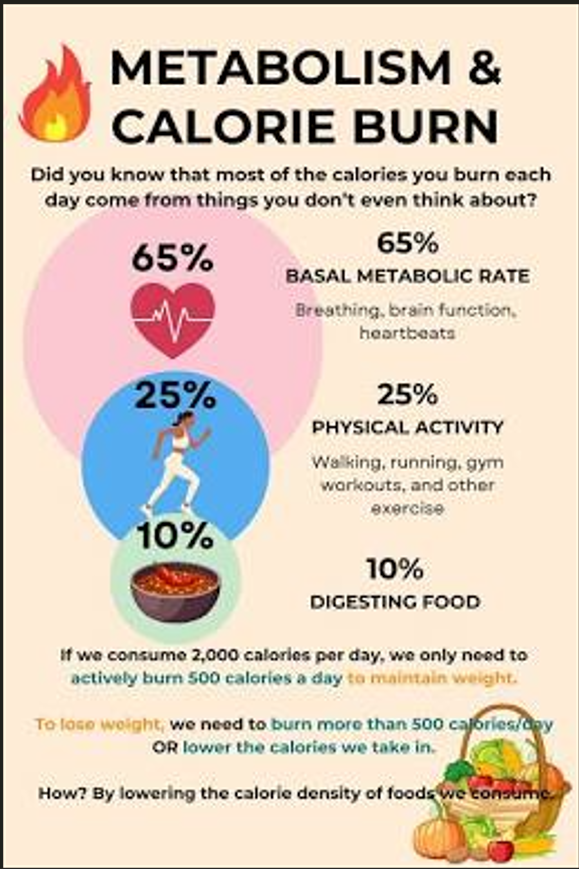
- Basal Metabolic Rate (BMR) (~60-75%): This is the energy your body needs just to stay alive while resting—breathing, circulating blood, and cellular repair. Even if you lay in bed all day, you are burning a massive chunk of your daily calories.
- The Thermic Effect of Food (TEF) (~10%): Fun fact: it takes energy to break down energy. Your body burns calories simply digesting, absorbing, and processing the food you eat. Protein takes the most energy to digest, burning off about 20-30% of its own calories just during digestion!
- Physical Activity (~15-30%): This includes deliberate exercise (like going for a run) and NEAT (Non-Exercise Activity Thermogenesis), which is everything from walking to your car to fidgeting at your desk.
Case Study: Why Volume and Composition Matter
A common trap people fall into is thinking “a calorie is just a calorie.” While thermodynamically true, biologically, where you get your calories changes how full you feel and how your body functions.
Consider this classic dietary experiment comparison:
| Food Option | Total Calories | Macro Split | Satiety (Fullness) Level |
| 1 Tablespoon of Olive Oil | ~120 kcal | 14g Fat | Very Low (Gone in one gulp) |
| 2 Large Boiled Eggs | ~140 kcal | 12g Protein, 10g Fat | High (Keeps you full for hours) |
| 3 Medium Apples | ~280 kcal | 75g Carbs, 13g Fiber | Extremely High (Massive physical volume) |
If you only track numbers blindly, you might think cutting out the apples or eggs makes sense because they have “more calories.” But because the eggs provide protein and the apples provide physical volume and fiber, they keep your hunger hormones quiet. The olive oil, while healthy, won’t stop your stomach from growling twenty minutes later.
Expert Opinion: The Psychological Friction of Tracking
Most nutritionists and behavioral psychologists agree on one thing: the best diet is the one you can actually stick to.
The biggest reason people give up on understanding their intake isn’t a lack of willpower; it’s friction. Traditional calorie tracking requires pulling out a digital scale, weighing 50 grams of spinach, searching a database, selecting the right brand, and manually logging it. Doing that three times a day feels like a part-time job.
The secret to long-term health isn’t precision to the exact decimal point; it’s building awareness and consistency over time. When you can look back at a weekly calendar and spot trends like realizing your energy crashes every Wednesday afternoon you unlock the power to make real changes.
A Smarter, Frictionless Way to Build Awareness
If you want to start understanding your body’s energy patterns without the headache of manual lookups, tools like our app, Diet Detect, are built to remove that exact friction.
Instead of typing and measuring every single ingredient, you can simply snap a picture of your plate or describe your meal in plain English (e.g., “I had a bowl of oatmeal with a handful of blueberries and a drizzle of honey”). The app’s AI analyzes the components, estimates the breakdown, and logs it instantly.
From there, it organizes your journey into a clean history calendar and visual analytics dashboard. You can see your macro trends over weeks or months, helping you connect how you eat with how you feel all without treating nutrition like a math exam.
Understanding calories shouldn’t feel like a punishment. It’s simply learning the language of your body’s energy.
Ready to see what’s actually on your plate? Download Diet Detect today on Android and start tracking your nutrition with a single photo.