

I used to think I ate pretty well.
Grilled chicken. Salads. Smoothies in the morning. I wasn’t eating fast food every night so why wasn’t the scale moving?
It took me an embarrassingly long time to figure it out. The olive oil I was “drizzling” on everything? That was probably 250 calories right there. The handful of mixed nuts I grabbed as a “healthy snack”? Another 200. The dressing on my virtuous salad? Could easily be 300 more.
I wasn’t overeating junk. I was overeating without knowing it.
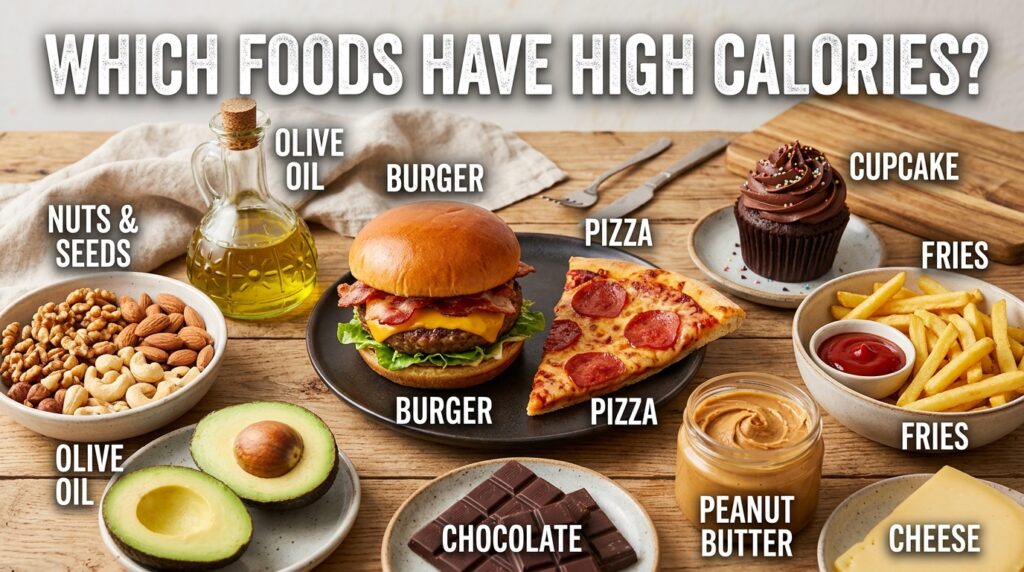
That’s the thing about high-calorie foods they don’t always look the part. And if you don’t understand where calories actually come from, you can eat “clean” all day and still wonder why nothing is changing.
So let’s talk about it properly. Not in a fear-mongering, avoid-everything way. Just honestly and practically.
First: Why Do Some Foods Have More Calories Than Others?
Calories are a unit of energy. Every macronutrient provides a different amount:
- Fat: 9 calories per gram (the most energy-dense macronutrient)
- Carbohydrates: 4 calories per gram
- Protein: 4 calories per gram
- Alcohol: 7 calories per gram (often forgotten)
Water has zero calories. Fiber has very few. This is why a cup of spinach (7 calories) and a tablespoon of olive oil (119 calories) can exist on the same plate water content and fat content make an enormous difference.
The key insight: calorie density (calories per gram or per serving) is what matters, not just the food itself.
The Foods That Are Genuinely High in Calories
1. Oils and Fats The Silent Heavyweights
Pure fat is the most calorie-dense substance you can eat. There’s no getting around the math.
| Fat/Oil | Serving | Calories |
|---|---|---|
| Olive oil | 1 tbsp | 119 |
| Coconut oil | 1 tbsp | 121 |
| Butter | 1 tbsp | 102 |
| Ghee | 1 tbsp | 112 |
| Avocado oil | 1 tbsp | 124 |
Here’s where people go wrong: they know oil is caloric, but they underestimate how much they use. A “drizzle” in practice is often 2–3 tablespoons. That’s 240–360 calories before the food itself.
Opinion worth sharing: I’m not saying avoid olive oil. It’s genuinely good for you. But measure it, at least for a few weeks, until you have a real sense of what a tablespoon actually looks like. Most people don’t.
2. Nuts and Nut Butters Deceptively Dense
Nuts are nutritional powerhouses protein, healthy fats, fiber, magnesium. They’re also extremely calorie-dense.
| Nuts | 1 oz (28g) | Calories |
|---|---|---|
| Macadamia | 1 oz | 204 |
| Pecans | 1 oz | 196 |
| Walnuts | 1 oz | 185 |
| Almonds | 1 oz | 164 |
| Cashews | 1 oz | 157 |
| Pistachios | 1 oz | 159 |
One ounce is roughly a small handful about 20–25 almonds. It’s very easy to eat three or four “handfuls” while watching TV and consume 600–800 calories without registering it as a meal.
Nut butters follow the same logic. Two tablespoons of peanut butter is around 190 calories and two tablespoons is a modest amount for someone who enjoys it.
3. Avocados Healthy and High-Calorie (Both Are True)
A medium avocado contains roughly 230–320 calories, almost entirely from fat. That doesn’t make it bad avocados are packed with monounsaturated fats, potassium, fiber, and folate. But one avocado is a substantial caloric contribution to any meal.
The trend of adding avocado to everything toast, salads, wraps, smoothies means many people are eating an extra 200–300 calories they haven’t accounted for. Again, not wrong. Just worth knowing.
4. Cheese Calories by the Slice
Cheese is beloved for good reason: it’s satisfying, it’s protein-rich, and it makes almost everything taste better.
| Cheese | 1 oz (28g) | Calories |
|---|---|---|
| Parmesan | 1 oz | 111 |
| Cheddar | 1 oz | 115 |
| Brie | 1 oz | 95 |
| Mozzarella (full fat) | 1 oz | 85 |
| Cream cheese | 1 oz | 98 |
The problem isn’t a slice of cheese. It’s that serving sizes in real life are generous a “handful” of shredded cheddar on pasta can easily be 3–4 oz (345–460 calories).
5. Fatty Meats Not Inherently Bad, But Calorie-Rich
There’s a big difference in calories between protein sources:
| Protein | 3 oz cooked | Calories |
|---|---|---|
| Chicken breast (skinless) | 3 oz | 128 |
| Salmon | 3 oz | 177 |
| Lamb shoulder | 3 oz | 235 |
| Pork belly | 3 oz | 295 |
| 80/20 ground beef | 3 oz | 215 |
This matters a lot if you’re eating protein as the centerpiece of every meal the source you choose dramatically affects your daily total.
6. Grains and Starches Depends on Volume
Plain cooked rice or pasta isn’t particularly calorie-dense per gram (it’s mostly water). But portions in practice tend to be large:
- 1 cup cooked white rice: 206 calories
- 1 cup cooked pasta: 220 calories
- 1 large bagel: 270–350 calories
- 1 croissant: 270–320 calories
- 1 cup granola: 450–600 calories
Granola deserves special mention. It’s marketed as a health food, but most commercial granolas are oil-dense and calorie-rich more like a dessert than a breakfast.
7. Alcohol The Overlooked Calorie Source
At 7 calories per gram, alcohol sits between carbs and fat in energy density and it adds up fast:
- 1 glass of wine (5 oz): ~125 calories
- 1 pint of beer: ~200 calories
- 1 cocktail with mixer: 200–350 calories
- 1 shot of spirits: ~100 calories
Alcohol is also unique in that it temporarily suppresses fat oxidation your body prioritizes metabolizing the alcohol, which means fat burning slows down while you drink. That’s worth understanding.
8. The Sneaky Category: Sauces, Dressings, and Condiments
This is where many people’s calorie accounting falls apart completely.
| Condiment/Sauce | Serving | Calories |
|---|---|---|
| Caesar dressing | 2 tbsp | 160 |
| Ranch dressing | 2 tbsp | 145 |
| Peanut sauce | 2 tbsp | 120 |
| Tahini | 2 tbsp | 178 |
| Mayonnaise | 1 tbsp | 94 |
| BBQ sauce | 2 tbsp | 60 |
| Hummus | 2 tbsp | 50 |
The reason this category catches people off-guard is that sauces aren’t thought of as food they’re thought of as flavoring. But pouring two to three servings of Caesar dressing on a salad adds 320–480 calories to what you mentally filed as “a light lunch.”
The Surprising Ones A Short Case Study
Meet Priya, 34, software engineer.
Priya came to dietary awareness after years of frustration. She exercised five days a week, ate “healthy,” and couldn’t understand why her weight wasn’t shifting. When she started actually tracking her food, she discovered:
- Her morning smoothie (banana, oat milk, peanut butter, protein powder, chia seeds): 620 calories
- Her “light” office lunch (grain bowl with tahini dressing): 750 calories
- Her pre-workout snack (trail mix): 310 calories
Her “healthy” day was well over 2,500 calories before dinner. She wasn’t eating badly she was just genuinely unaware of what each component contributed.
This isn’t rare. Research consistently shows that people underestimate their calorie intake often by 20–40%. The issue isn’t willpower or dishonesty. It’s that we’ve never been given the tools to see our food clearly.
High-Calorie Doesn’t Mean Bad
It’s worth saying explicitly: calorie density isn’t a moral quality.
Salmon is high in calories. It’s also one of the most nutritious things you can eat. Avocados are calorie-dense. They’re also extraordinary for heart health. Whole nuts are calorically significant. They’re also associated with reduced cardiovascular risk in study after study.
The question isn’t “is this food high in calories?” The question is: does this fit my daily intake, and do I know what it’s contributing?
That’s where awareness becomes the actual tool, not restriction.
The Practical Challenge: We Eat Visually, Not Mathematically
Here’s the real difficulty. Even if you read every table in this article and memorize every calorie count, you’re still making food decisions with your eyes not a calculator.
You see a bowl. You fill it. You eat it.
Unless you’re weighing everything and logging every entry manually (which most people don’t sustain long-term), the gap between “what you think you ate” and “what you actually ate” stays frustratingly wide.
This is genuinely hard. And I think it’s worth acknowledging rather than just saying “track your calories” as if it’s simple.
Some people have found that the key isn’t more discipline it’s making the tracking process fast enough that it actually happens. That might mean using a photo-based app that does the estimation for you, or simply describing what you ate in natural language and letting the technology interpret it. Tools like Diet Detect were built for exactly this reason snap a photo of your plate, or just describe what you had, and get a calorie and nutrition breakdown without manually searching a database. It’s not perfect, but it lowers the friction enough that people actually stick with it. And over time, the history and analytics features help you spot the patterns that matter not just today’s lunch, but the trends across weeks.
Whether you use an app or a notebook or just become more mindful, the goal is the same: to see your eating more clearly, so you can make choices you actually intend to make.
Quick Reference: Calorie Density Summary
| Category | Calories per 100g | Notes |
|---|---|---|
| Oils | 880–900 | Highest of anything |
| Nuts | 550–720 | Varies by type |
| Cheese | 300–420 | Higher for aged varieties |
| Dried fruits | 250–350 | Sugar concentrates calories |
| Fatty meats | 200–350 | Varies significantly |
| Bread/bagels | 240–280 | Portion size is the variable |
| Cooked rice/pasta | 130–220 | Much less than dry weight |
| Fruits | 30–80 | Low density, except avocado |
| Vegetables | 15–50 | Very low density |
| Leafy greens | 5–25 | Almost negligible |
What To Do With This Information
You don’t need to eat differently today. But you might want to spend a week actually paying attention not to restrict yourself, but just to see what’s really happening.
A few practical starting points:
1. Measure your oils for one week. Just this. It will surprise you.
2. Read the label on your dressings. Check what a serving size is, and check how much you actually use.
3. Notice your nut and nut butter portions. They’re often double what the serving size says.
4. Account for alcohol in your mental model. It has real calories and affects metabolism.
5. Don’t be afraid of high-calorie healthy foods just know what they contribute. Salmon, avocado, olive oil, and nuts belong in a healthy diet. Just with clear eyes.
Awareness is the starting point and once you have it, the choices tend to get easier.
Final Thought
The most useful thing I ever did for my nutrition wasn’t going on a diet. It was simply understanding what I was actually eating without judgment, without restriction, just clearly.
High-calorie foods are everywhere. Some of them are incredibly good for you. Some of them are worth reducing. Most of them just need to be seen for what they are.
Once you can see your food clearly, you’re already most of the way there.
Want to make calorie awareness a daily habit? Diet Detect lets you track what you eat by taking a photo or describing your meal in plain language no database-diving, no guesswork. It builds a nutritional history over time so you can spot your own patterns. Worth a look if you’re curious.
author: “mydietdetect.com Editorial Team”